
Why IT leaders should pay attention to Canva’s ‘imagination era’ strategy
The rise of AI marks a critical shift away from decades defined by information-chasing and a push for more and more compute power.
Canva co-founder and CPO Cameron Adams refers to this dawning time as the “imagination era.” Meaning: Individuals and enterprises must be able to turn creativity into action with AI.
Canva hopes to position itself at the center of this shift with a sweeping new suite of tools. The company’s new Creative Operating System (COS) integrates AI across every layer of content creation, creating a single, comprehensive creativity platform rather than a simple, template-based design tool.
“We’re entering a new era where we need to rethink how we achieve our goals,” said Adams. “We’re enabling people’s imagination and giving them the tools they need to take action.”
An 'engine' for creativity
Adams describes Canva’s platform as a three-layer stack: The top Visual Suite layer containing designs, images and other content; a collaborative Canva AI plane at center; and a foundational proprietary model holding it all up.
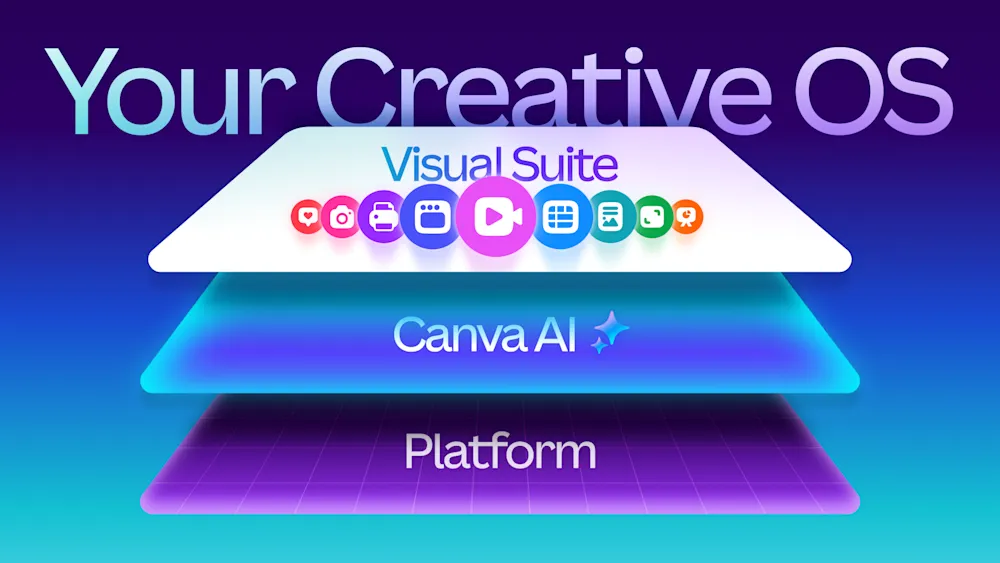
At the heart of Canva’s strategy is its Creative Operating System (COS) underlying. This “engine,” as Adams describes it, integrates documents, websites, presentations, sheets, whiteboards, videos, social content, hundreds of millions of photos, illustrations, a rich sound library, and numerous templates, charts, and branded elements.
The COS is getting a 2.0 upgrade, but the crucial advance is the “middle, crucial layer” that fully integrates AI and makes it accessible throughout various workflows, Adams explained. This gives creative and technical teams a single dashboard for generating, editing and launching all types of content.
The underlying model is trained to understand the “complexity of design” so the platform can build out various elements — such as photos, videos, textures, or 3D graphics — in real time, matching branding style without the need for manual adjustments. It also supports live collaboration, meaning teams across departments can co-create.
With a unified dashboard, a user working on a specific design, for instance, can create a new piece of content (say, a presentation) within the same workflow, without having to switch to another window or platform. Also, if they generate an image and aren’t pleased with it, they don’t have to go back and create from scratch; they can immediately begin editing, changing colors or tone.
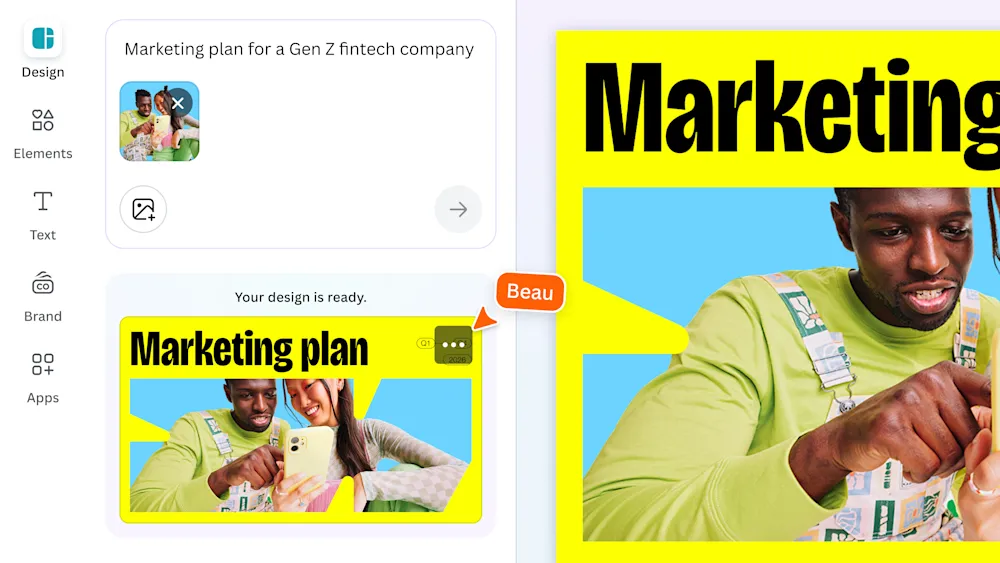
Another new capability in COS, “Ask Canva,” provides direct design advice. Users can tag @Canva to get copy suggestions and smart edits; or, they can highlight an image and direct the AI assistant to modify it or generate variants.
“It’s a really unique interaction,” said Adams, noting that this AI design partner is always present. “It’s a real collaboration between people and AI, and we think it’s a revolutionary change.”
Other new features include a 2.0 video editor and interactive form and email design with drag-and-drop tools. Further, Canva is now incorporated with Affinity, its unified app for pro designers incorporating vector, pixel and layer workflows, and Affinity is “free forever.”
Automating intelligence, supporting marketing
Branding is critical for enterprise; Canva has introduced new tools to help organizations consistently showcase theirs across platforms. The new Canva Grow engine integrates business objectives into the creative process so teams can workshop, create, distribute and refine ads and other materials.
As Adams explained: “It automatically scans your website, figures out who your audience is, what assets you use to promote your products, the message it needs to send out, the formats you want to send it out in, makes a creative for you, and you can deploy it directly to the platform without having to leave Canva.”
Marketing teams can now design and launch ads across platforms like Meta, track insights as they happen and refine future content based on performance metrics. “Your brand system is now available inside the AI you’re working with,” Adams noted.
Success metrics and enterprise adoption
The impact of Canva’s COS is reflected in notable user metrics: More than 250 million people use Canva every month, just over 29 million of which are paid subscribers. Adams reports that 41 billion designs have been created on Canva since launch, which equates to 1 billion each month.
“If you break that down, it turns into the crazy number of 386 designs being created every single second,” said Adams. Whereas in the early days, it took roughly an hour for users to create a single design.
Canva customers include Walmart, Disney, Virgin Voyages, Pinterest, FedEx, Expedia and eXp Realty. DocuSign, for one, reported that it unlocked more than 500 hours of team capacity and saved $300,000-plus in design hours by fully integrating Canva into its content creation. Disney, meanwhile, uses translation capabilities for its internationalization work, Adams said.
Competitors in the design space
Canva plays in an evolving landscape of professional design tools including Adobe Express and Figma; AI-powered challengers led by Microsoft Designer; and direct consumer alternatives like Visme and Piktochart.
Adobe Express (starting at $9.99 a month for premium features) is known for its ease of use and integration with the broader Adobe Creative Cloud ecosystem. It features professional-grade templates and access to Adobe’s extensive stock library, and has incorporated Google's Gemini 2.5 Flash image model and other gen AI features so that designers can create graphics via natural language prompts. Users with some design experience say they prefer its interface, controls and technical advantages over Canva (such as the ability to import high-fidelity PDFs).
Figma (starting at $3 a month for professional plans) is touted for its real-time collaboration, advanced prototyping capabilities and deep integration with dev workflows; however, some say it has a steeper learning curve and higher-precision design tools, making it preferable for professional designers, developers and product teams working on more complex projects.
Microsoft Designer (free version available; although a Microsoft 365 subscription starting at $9.99 a month unlocks additional features) benefits from its integration with Microsoft’s AI capabilities, Copilot layout and text generation and Dall-E powered image generation. The platform’s “Inspire Me” and “New Ideas” buttons provide design variations, and users can also import data from Excel, add 3D models from PowerPoint and access images from OneDrive.
However, users report that its stock photos and template and image libraries are limited compared to Canva's extensive collection, and its visuals can come across as outdated.
Canva’s advantage seems to be in its extensive template library (more than 600,000 ready-to-use) and asset library (141 million-plus stock photos, videos, graphics, and audio elements). Its platform is also praised for its ease of use and interface friendly to non-designers, allowing them to begin quickly without training.
Canva has also expanded into a variety of content types — documents, websites, presentations, whiteboards, videos, and more — making its platform a comprehensive visual suite than just a graphics tool.
Canva has four pricing tiers: Canva Free for one user; Canva Pro for $120 a year for one person; Canva Teams for $100 a year for each team member; and the custom-priced Canva Enterprise.
Key takeaways: Be open, embrace human-AI collaboration
Canva’s COS is underpinned by Canva’s frontier model, an in-house, proprietary engine based on years of R&D and research partnerships, including the acquisition of visual AI company Leonardo. Adams notes that Canva works with top AI providers including OpenAI, Anthropic and Google.
For technology teams, Canva’s approach offers important lessons, including a commitment to openness. “There are so many models floating around,” Adams noted; it’s important for enterprises to recognize when they should work with top models and when they should develop their own proprietary ones, he advised.
For instance, OpenAI and Anthropic recently announced integrations with Canva as a visual layer because, as Adams explained, they realized they didn’t have the capability to create the same kinds of editable designs that Canva can. This creates a mutually-beneficial ecosystem.
Ultimately, Adams noted: “We have this underlying philosophy that the future is people and technology working together. It's not an either or. We want people to be at the center, to be the ones with the creative spark, and to use AI as a collaborator.”